
Platform access
Access ESG datasets directly through the Dataland platform and download them in structured formats
Browse, search, and download
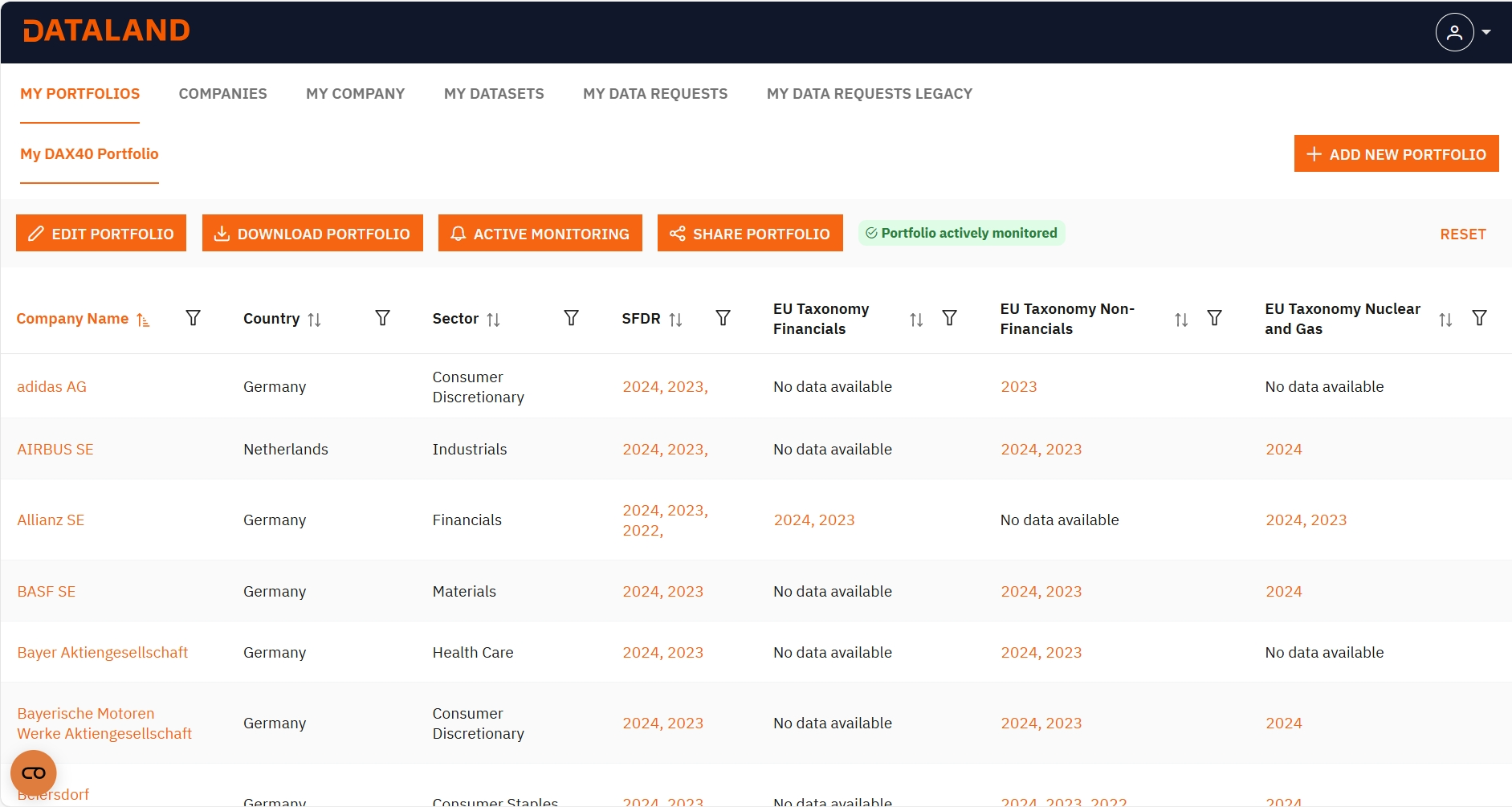
Browse companies, portfolios and datasets interactively
Access and use Dataland in the way that fits your team.
Access ESG datasets directly through the Dataland platform and download them in structured formats
Browse companies, portfolios and datasets interactively
Integrate Dataland data into your internal systems and analytics pipelines
Retrieve ESG datasets programmatically through stable APIs
Access Dataland data through software partners and ESG data platforms
Partners integrate Dataland datasets into their own solutions
Members can use all data available on the platform or request additional datasets as needed.
Use the dataset within the platform or download it for your internal applications
✓Free of charge✓Data available for immediate useRequest the dataset from your account on the platform
✓Delivery within a month✓Shared costs for members requesting the same datasetCore platform capabilities for accessing, managing, and exporting Dataland data in daily workflows.
Download datasets as CSV or XLSX with or without metadata.
Build your own portfolios of companies and monitor ESG data availability.
Share company portfolios with colleagues and teams.
Order missing datasets directly through the platform.
Inspect original source documents and quality comments.
Export datasets in formats suitable for different reporting frameworks.
Dataland supports different ESG data use cases across reporting, analysis, and portfolio workflows.
Dataland serves as the main source of ESG datasets, with data retrieval, reporting, and analysis processes built directly on its datasets. Reliance on expensive ESG data monopolists can be reduced or eliminated.
Dataland complements a primary ESG data provider by closing remaining data gaps. This includes access to ESG data for SMEs and private companies that are typically not covered by large commercial vendors, extending ESG analysis beyond listed entities and enabling broader coverage of real-economy exposures, especially in lending, private markets, and insurance portfolios.
Dataland datasets serve as an additional reference point to cross-check consistency, plausibility, and methodological differences against a primary provider - particularly in contexts requiring high data quality and auditability. Every data point is linked to its exact location in the original source document, providing the source transparency that regulatory audits increasingly require.
Retrieval of ESG datasets for defined portfolios (e.g. loan books or investment portfolios), combined with continuous identification of newly available data. Portfolio coverage remains up to date as holdings evolve and additional datasets become available.
Missing datasets for specific companies or indicators can be ordered via credits, driven by concrete internal or regulatory requirements. This enables precise data procurement without dependency on predefined data packages.
Provision of EU Taxonomy datasets in both current and previous template formats, including automated format conversion. Ensures continuity in internal reporting processes when regulatory templates change.
These use cases support different business areas across the company.
Real-world experiences show how organizations use Dataland to solve ESG data challenges in practice.

As an asset manager with sustainability reporting obligations, MEAG requires reliable ESG indicators across a large universe of portfolio companies. The firm uses Dataland to verify data quality and close specific data gaps that arise in the datasets delivered by its primary ESG data provider, both for internal purposes and to demonstrate reasonable effort to auditors. At the same time, MEAG expects Dataland's EU Taxonomy template conversion capability to simplify the upcoming transition to the revised reporting template.
For SFDR reporting, MEAG must compile a range of sustainability indicators across a large universe of portfolio companies. While the firm's main ESG data provider covers most of the required data, some indicators needed for PAI calculations are not always included in the delivered datasets. In some cases, there is no data available at all for certain companies from the primary provider.
MEAG uses Dataland as a data source to close specific SFDR data gaps. When indicators required for PAI reporting are missing from the firm's primary dataset or there is no dataset available for that firm from the primary data provider, the reporting team retrieves the relevant ESG indicators from Dataland.
Traceable sourcing and documentation strengthen audit readiness and simplify demonstrating reasonable effort. The ability to cross-check data improves overall data quality and reduces reliance on a single provider.
Read full story →“Dataland provides a reliable way to close specific SFDR data gaps in our reporting and to obtain required data quickly upon request. The upcoming EU Taxonomy template conversion is a key additional benefit, as it removes the need to build and maintain our own format conversion. The platform also helps us document reasonable effort where data cannot be sourced and gives us an additional basis for validating data delivered by our primary provider.”

NORD/LB uses ESG indicators across several regulatory and internal reporting processes. The bank selected Dataland for EU Taxonomy reporting because it provides high-quality, disclosure-based indicators at a competitive price while allowing the bank to retrieve only the specific datasets required for its reporting workflows. Instead of purchasing large bundled ESG data packages, NORD/LB requests and obtains EU Taxonomy data exactly for the companies it needs. The datasets are now integrated directly into the bank's internal systems via API, replacing an earlier manual data retrieval process.
For EU Taxonomy, NORD/LB must compile sustainability indicators for a broad range of corporate counterparties. Traditional ESG data providers typically offer large data packages covering thousands of indicators and analytics. For banks that only require a limited number of specific metrics for regulatory reporting, this model often leads to high costs and unnecessary data procurement. When NORD/LB began using Dataland, the required datasets were initially retrieved manually from the platform and transferred into the bank's internal reporting systems. While this approach provided access to the necessary ESG indicators, it required manual downloads and additional handling steps during each reporting cycle. As ESG reporting requirements evolved, this manual workflow created additional operational effort for the reporting team.
NORD/LB adopted Dataland as its primary ESG data source for the Taxonomy KPIs of its counterparties that are subject to non-financial reporting, allowing the bank to obtain the specific datasets required for its regulatory reporting processes without purchasing large and expensive data bundles. To streamline the workflow further, the bank implemented a direct API integration with the Dataland platform. Through this integration, the required ESG datasets are automatically retrieved and transferred into the bank's internal reporting infrastructure. This ensures that the latest available data is delivered directly to the relevant reporting processes without manual intervention.
Using Dataland allows NORD/LB to combine a targeted ESG data procurement model with automated data delivery. The bank receives disclosure-based ESG indicators with transparent lineage, pays only for the datasets needed for its reporting workflows, and integrates the data directly into internal systems through API access. The transition from manual downloads to automated integration has significantly reduced operational effort for the reporting team while ensuring that ESG datasets are delivered consistently and reliably to the bank's regulatory reporting processes.
Read full story →“The combination of high-quality disclosure-based data, a transparent pricing model, and API integration makes Dataland a very efficient ESG data source for our reporting workflows.”

Oeffentliche Versicherung Braunschweig (OeVB) must report sustainability indicators for its investment portfolios under the Sustainable Finance Disclosure Regulation (SFDR). In particular, the calculation of Principal Adverse Impact (PAI) indicators requires reliable and traceable ESG data for portfolio companies.
For SFDR reporting, insurers must be able to demonstrate that the ESG indicators used in their PAI calculations are reliable and properly documented. In practice, this means that the values used in regulatory reporting must be traceable back to the underlying company disclosures.
OeVB therefore uses Dataland as a complementary ESG data source specifically for validation purposes. For selected portfolio companies and PAI indicators, the reporting team retrieves the corresponding datasets from Dataland.
The reporting team can demonstrate to internal stakeholders and external auditors that the PAI values used in the calculations are consistent with the underlying issuer disclosures.
Read full story →“Dataland provides us with a reliable way to verify that the PAI indicators used in our reporting match the issuer's disclosures. This makes it much easier to demonstrate the correctness of our data during audits while giving us access to high-quality ESG data in a very cost-efficient way.”
A straightforward membership model with transparent pricing and shared sourcing costs.
For this fee, everything already available on the platform is free for all Members:
All datasets available on Dataland can be accessed and used for internal purposes without restrictions.
Current features, from download to template conversion, as well as all future features we will develop, are free for all members.
Missing datasets can be requested and automatically delivered through Active Portfolio Monitoring.
for requesting missing datasets.
The cost of sourcing datasets is shared among members requesting the same data.
Members can use the credits received with their annual subscription and purchase additional credits for EUR 50 per credit.
Credits are only used when new data is sourced. All datasets already on the platform are included at no additional cost.
Dataset = 1 company, 1 framework, 1 reporting period.
| # of Members | Cost (Credits) |
|---|---|
| 1 | 1 |
| 2 | 0.5 |
| 3 | 0.4 |
| 4 | 0.3 |
| 5-9 | 0.2 |
| > 10 | 0.1 |
The more members request the same company, the lower the cost per dataset.
Join now to access high-quality ESG data and be part of building a non-profit European data infrastructure.
Technical documentation enables seamless integration and efficient use of the platform.
Understand the data frameworks and structures behind Dataland - coverage, field definitions, and supported standards.
Interactive Swagger documentation for every Dataland service.
Ready to get started?